Nanao Keyboard, the new Keyboard design for a narrower keyboard!
1. How can we prevent the upper parts of the white key “so” and “la” from becoming so narrow?
It seems almost inevitable that on narrower keyboards, the upper parts of “so” and “la” become very tight, making it difficult for the tip of a finger to strike the space between black keys.
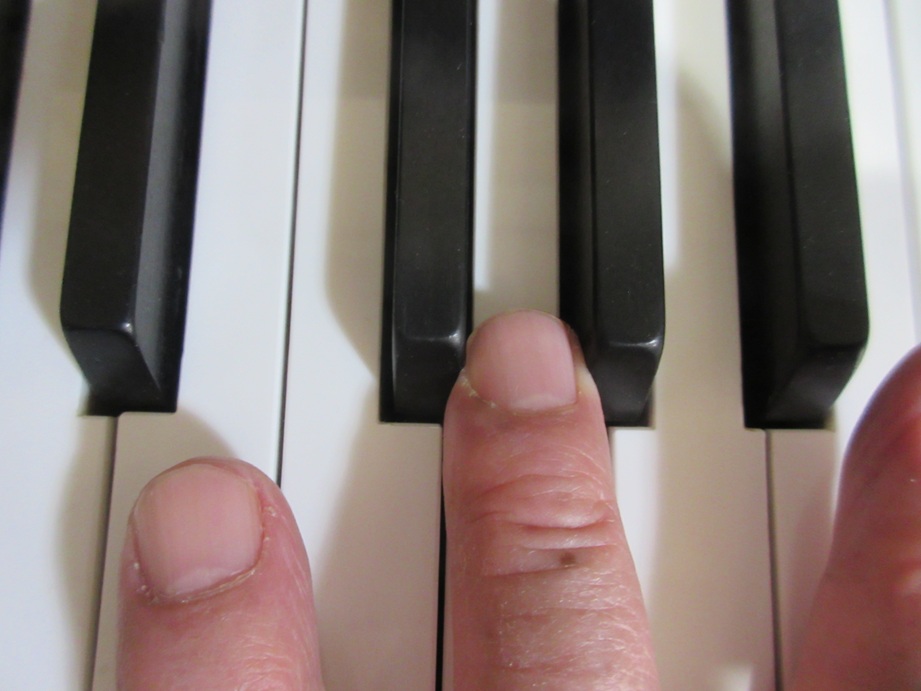
(DS 5.5 Top of Steinbuhler-Walter’s white key So. The Finger does not fit.)
Some manufacturers attempted to solve the problem by filing down the sides of the black keys to increase the space between them.
As a result, the black keys became narrower and pianists have to skip the black keys when playing.
Here good news. The Nanao Keyboard (public domain), an original idea of me, Nanao Hayasaka, solves the problem. The rooms between black keys become wider and black keys can be also wider.
This was made possible by designing the white keys differently in two groups.
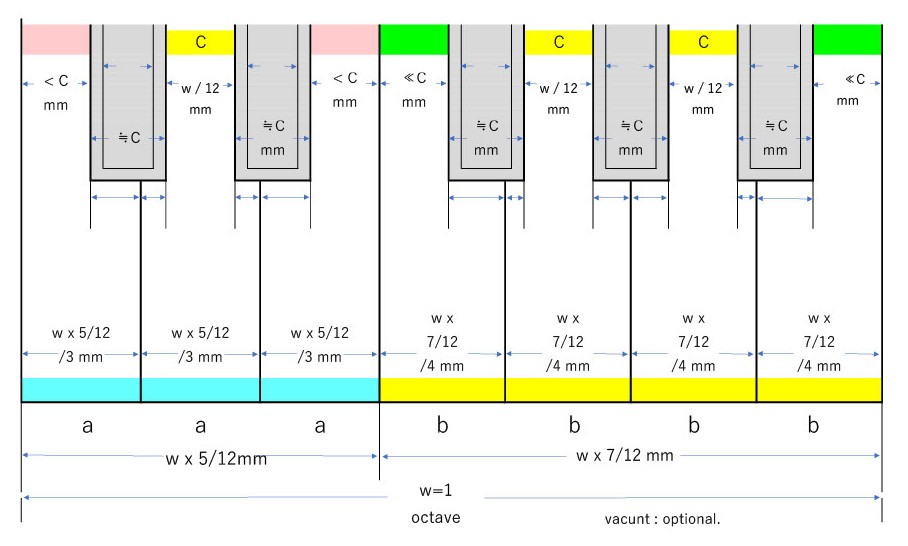
You can replace it with “w,” for example, 165 on a conventional keyboard. Similarly 153 for DS 6.0, oder 140,7 for DS 5.5.
2. Two errors of the standard keyboard.
The standard keyboard has two failures.
(1) Fixing the size, and fixing it for “Big Hands”. Pianos manufactured, sold, and played around the world today have standard keyboards. All are standardized to DS 6.5 (165 mm per octave). This octave width is too large.
To play well, the span (distance between 1~5 fingers) needs to be 24cm to 26cm.
In fact, about 80% of female pianists and 25% of male pianists cannot play the piano well. We need a piano for “Little Hands”. My span is 20.5cm. I cannot play the standard keyboard.
(2) Uniform of white key width.
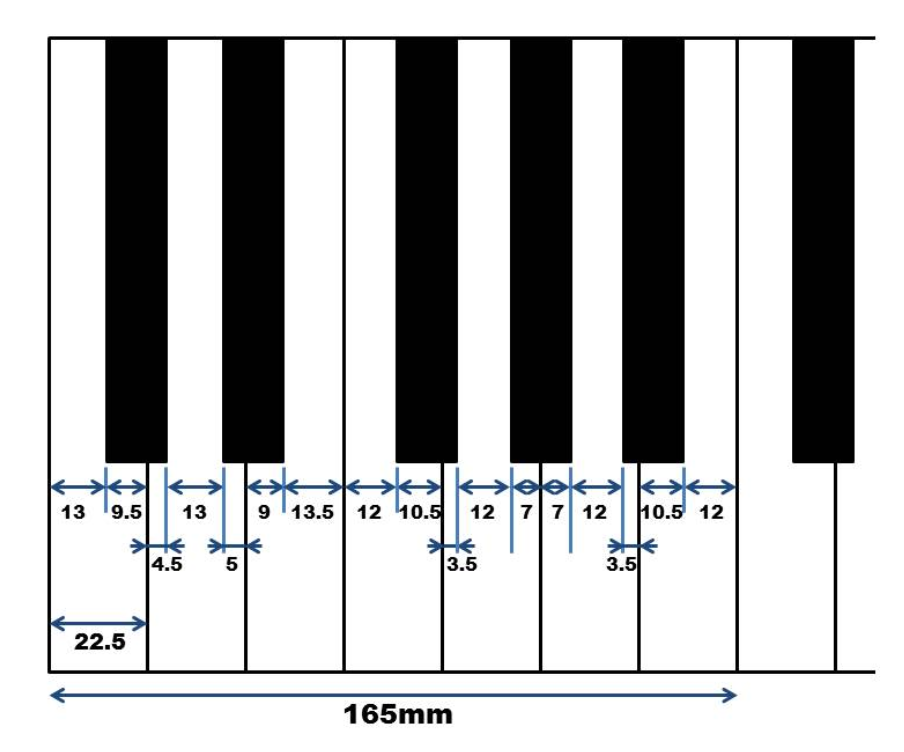
(Bechsteins tastatur.)
In the current standard keyboard, all the white keys are uniform in width. On the other hand, the width of the upper part of the white keys (so and la) is narrower than the width of the upper part of the white key (re). The figure shows a keyboard diagram of a Bechstein (standard keyboard, 165 mm per octave). The upper part of the white key “Re” is 13 mm. The upper part of white keys “so” and “la” is 12mm. *The problem is that the fingers of the “big hands” are not able to enter or exit the upper part of the “so” and “la”.
3. How did this happen?
The question of “how to accommodate the piano’s 12 octave keyboard rods” is involved here.
First, the white keys are divided into the three do-re-mi keys and the four fa-so-la-si keys. Between the three Do-Re-Mi keys, two black keys, Do # and Re #, are placed. Total: 5 rods.
However, between the four Fa-So-La-Si keys, three black keys (F♯, So♯, and La♯) are inserted between the four rods. Total 7 rods.
Therefore, five spaces are needed for the white key do-re-mi, and seven spaces are needed for the fa-so-la-si part.
In other words, the white do-re-mi key requires 5/12 of an octave, and the white fa-so-la-ci key requires 7/12 of an octave.
If w (width) is the octave, the width of each key is defined as follows (This is Nanao Hayasaka’s original design as a general-purpose keyboard configuration.) In other words, whether the octave is 165 mm on the standard keyboard or 153 mm on the DS 6.0 keyboard, it will be available as same as 140mm on the DS 5.5 keyboard. (w=140) Mr. Steinbuehler called it “Wonderful!”.
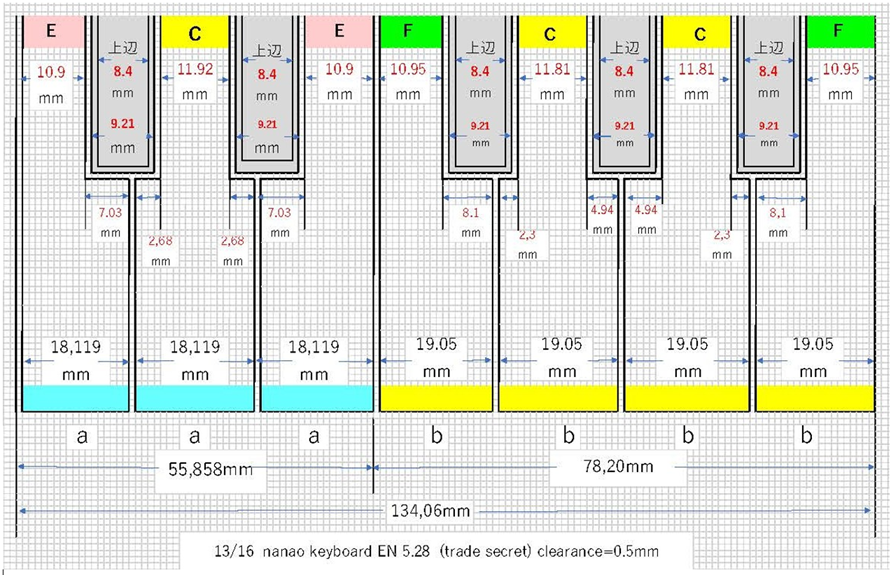
This makes white key b (fa-so-la-ci) slightly wider than white key a (do-re-mi).
This allows for equal space in the upper white keys of the re, so, and la.
However, all standard keyboards, including the Bechstein mentioned above, gave priority to “equalizing the width of the white keys”. As a result, the upper part of the white keys, So and La, became narrower. (Furthermore. Some makers shave the sides of the black keys to make the tops of So and La wider.)
4. An example of design for DS 5.28
I think DS 5.5 is still too big for Japanese women with small hands. 5.28 would be more suitable for them. I hope that in the future, every pianist with different hand sizes will be able to find a suitable keyboard.
Posted on 10. February 2026 by Nanao Hayasaka.